
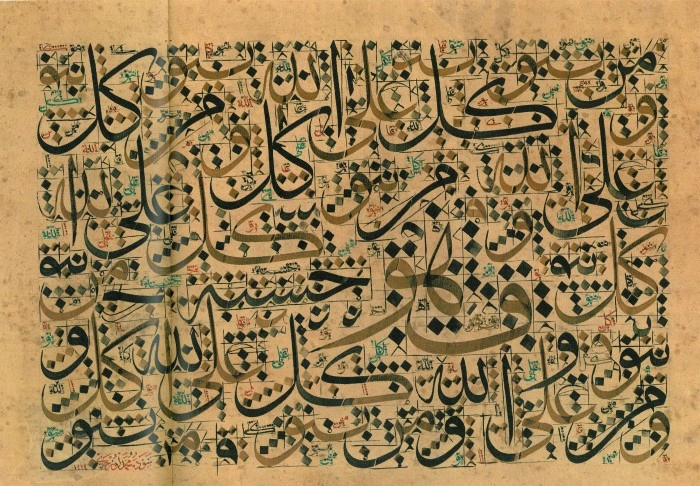
From Ink to Meaning: The Secret of Calligraphy’s Endurance and Popularity
- tags art, calligraphy, history
Abstract
The Secret of Calligraphy’s Endurance and Popularity”, explores the historical, social, religious, and artistic factors behind the longevity of calligraphy in Islamic and Iranian culture. Using a descriptive–analytical approach, it demonstrates that calligraphy is not merely a tool for conveying meaning, but an art deeply connected with the calligrapher’s personal identity, with social and religious beliefs, and with contemporary needs. The paper is divided into three main sections: the philosophical and inspirational roots of calligraphy, its role in the modern world, and the significance of branding in the art of calligraphy. The findings reveal that the secret of its endurance lies in the unique fusion of beauty, meaning, and functionality, as well as in its ability to create a bridge between tradition and modernity. Ultimately, the article concludes that calligraphy is a universal language that transcends geography and speaks directly to the human spirit.
Keywords
Calligraphy, Branding, Semiotics, Tradition and Modernity, Islamic Art, Architecture, Personal Identity
Table of Contents
- Introduction
- Inspirations and Philosophy of Calligraphy
2.1 Art as Utility
2.2 The Added Value of Art
2.3 Calligraphy as a Silent Therapist
2.4 The Eastern Secret of Calligraphy
2.5 Comparison with Painting
2.6 The Existential Test of Art
2.7 The Role of Place in Displaying the Art
2.8 Diversity of Scripts as Languages of Meaning
2.9 Variety of Scripts as Cultural Witness
2.10 Inherent Meaning in Calligraphy
2.11 The Role of Past Social Beliefs in Calligraphy
2.12 Calligraphy and Religious Beliefs
- Calligraphy in the Contemporary World
3.1 Endurance in the Age of Machines
3.2 Tradition and Modernity
3.3 The Globalization of Calligraphy
3.4 Economy and the Calligraphy Market
3.5 The Artist’s Livelihood and the Survival of the Art
3.6 The Multifaceted Role of Calligraphy in Art
- Branding in Calligraphy
4.1 Calligraphy and Personal Branding
4.2 The Impact of the Calligrapher’s Signature on the Emergence of Schools
4.3 Calligraphy as a Bridge Between Tradition and Modernity
- Conclusion
- References
Introduction
Writing has always been one of humanity’s deepest desires: a longing to record thought and preserve emotion. From the earliest ages, when humankind carved primitive signs upon cave walls and stone, there was a search for a way to communicate beyond image—a way to entrust inner feelings and ideas to others.
In its beginning, script was something between drawing and sign: it bore both image and meaning. This unique fusion elevated script beyond a mere instrument of communication and transformed it into a canvas for artistic creation. From the union of “ink” and “meaning,” calligraphy was born—an art that not only conveys a message but also creates beauty and summons the soul to serenity. This is why calligraphy endures, living on to this day, still touching the hearts of humankind.
Methodology
This research has been conducted using a descriptive–analytical approach. Sources include classical texts on calligraphy, contemporary academic studies, and real-life examples from architecture and the calligraphy art market. The data have been examined through qualitative content analysis to reveal the philosophical, social, and practical dimensions of calligraphy.
2.1 Art as Utility
Art attains its true value when it moves beyond mere ornamentation and becomes a useful part of daily life. Art that remains purely decorative is destined, sooner or later, to fade into obscurity or survive only as a luxury for the few. Calligraphy, however, has preserved a living and dynamic place for itself—present in homes, in sacred spaces, and in contemporary contexts alike.
2.2 The Added Value of Art
Calligraphy is not only an expression of feeling; it creates benefits beyond beauty. It can inspire creativity, reinforce social cohesion, and strengthen spiritual faith. These added values at times surpass the importance of the work itself, showing that calligraphy is an art rooted in meaning, not in form alone.
2.3 Calligraphy as a Silent Therapist
The contemplation of calligraphy—even without understanding the words—can draw the soul into profound tranquility. The rhythm of pen strokes, the rise and fall of lines, carries a music that quiets the restless mind and brings the heart to stillness. Calligraphy is thus a silent therapist, opening windows of calm with every movement of the pen.
2.4 The Eastern Secret of Calligraphy
Calligraphy flourished in the East, where art was created not merely for the eye, but for the spirit. In these cultures, writing was never just an instrument of communication but a mirror of the soul and a gateway to contemplation. Even for those who do not know the meaning of the words, the flow of the pen evokes an experience of reflection and peace—a quality rare among other arts.
2.5 Comparison with Painting
Painting requires a wide array of elements—color palettes, technical mastery, and complex composition—to achieve impact. Calligraphy, in contrast, with nothing more than pen and ink, can produce works of profound depth. While most audiences are drawn to the vibrancy of color in painting, calligraphy has the power to captivate with the simplest of contrasts: black ink on white paper.
2.6 The Existential Test of Art
Every artwork must face this question: why was it created, and what role does it serve in human life? Calligraphy passes this test with dignity, for it is not only beautiful but also answers spiritual and moral needs. A fine line of script becomes a bridge between the artist and the beholder, fostering a dialogue that heals and uplifts.
2.7 The Role of Place in Displaying the Art
Since ancient times, calligraphy has held a prominent role in architecture. Sacred verses and holy words inscribed upon walls and domes created spaces that invited silence, reflection, and spiritual presence. Historical examples such as the inscriptions of the Sheikh Lotfollah Mosque in Isfahan or the monumental calligraphy of Hagia Sophia in Istanbul demonstrate how script has linked space to meaning.
2.8 Diversity of Scripts as Languages of Meaning
Islamic calligraphy was never confined to a single script. Kufic, Rayhani, Ruq‘ah, Ta‘liq, Nasta‘liq, Thuluth, and Naskh—each emerged as an effort to reveal a different dimension of the spirit within words. This variety not only gave rise to visual diversity but also created pathways to bring meaning closer to the heart and mind of the beholder.
2.9 Variety of Scripts as Cultural Witness
The multiplicity of calligraphic schools is itself testimony to the profound place of this art in the East. Were calligraphy of little importance, such a rich heritage of styles would never have developed, nor survived to this day. We are the heirs of this priceless legacy.
2.10 Inherent Meaning in Calligraphy
Calligraphy carries meaning not only through the words it renders but also through the movement of the pen itself. The curves, the rhythm, the dance of the script—all communicate meaning. Even when the words are not understood, the line itself leads the viewer into an experience of reflection and inner calm.
2.11 The Role of Past Social Beliefs in Calligraphy
Calligraphy was not merely an art but held a special place in social beliefs of the past. For example, children were once forbidden to write with the left hand, for the left was associated with impurity. Today we know such views were rooted in superstition, yet this practice reveals the reverence with which writing was regarded.
Respect was also extended to the tools of writing. Papers bearing sacred names, when no longer usable, were immersed in flowing water or respectfully buried. Broken pens, too, were laid to rest as objects of honor. Even pupils in traditional schools would purify themselves before touching the pen—signifying the link between writing, ritual purity, and spiritual devotion.
2.12 Calligraphy and Religious Beliefs
The Qur’an itself contains a chapter named Al-Qalam (“The Pen”), which begins with God’s oath by the pen. This divine testimony elevated writing and calligraphy to a sacred status among Muslims. Traditional calligraphers believed that every work must begin with the remembrance of God, and so the opening line was almost always adorned with the phrase “Bismillah al-Rahman al-Rahim” (“In the name of God, the Most Merciful, the Most Compassionate”).
For many of them, the act of cutting a reed pen and dipping it into ink was not a mechanical gesture but a spiritual ritual. Thus, throughout centuries, calligraphy was both art and devotion: a means of remembrance, a path of closeness to the Divine, an expression of worship preserved to this day.
Transition
“All these philosophical foundations, together with the social and religious beliefs surrounding calligraphy, show that it was never merely an art form, but an essential part of human life. These deep cultural and spiritual roots prepared the ground for calligraphy’s continued presence in the modern world, where it adapts and thrives under new conditions.”
3.1 Endurance in the Age of Machines
In an era when many arts have been diminished or replaced by technology, calligraphy remains vibrant and steadfast. No machine has ever succeeded in replicating the delight of beholding an original line of script. For the modern individual, surrounded by mechanical devices and digital images, calligraphy offers a sanctuary of the soul—a reminder that beauty and meaning cannot be entrusted to cold circuits and screens.
3.2 Tradition and Modernity
Contemporary calligraphy is undergoing a transformation. Artists today weave traditional principles with modern and abstract languages, creating works that are at once rooted in the past and reaching toward the future. While some traditionalists see this shift as a threat to authenticity, in truth it has infused new life into the art, drawing younger generations toward it. In this blending of tradition and innovation, calligraphy has not only survived but flourished in the modern age.
3.3 The Globalization of Calligraphy
Calligraphy has crossed geographical boundaries. Today, works of calligraphers are displayed in homes and galleries across Europe, America, and far beyond, gaining recognition at international exhibitions and auctions. This global presence reveals calligraphy’s status as a universal language—one that communicates directly with human emotion, regardless of linguistic barriers. Just as it once brought solace to hearts in the East, it now speaks equally to audiences in both East and West.
3.4 Economy and the Calligraphy Market
In earlier times, calligraphy was esteemed mainly by the learned and the devout. Today, however, its audience has expanded greatly. Growing interest has brought prosperity to the calligraphy market, and works now command places of honor in galleries and auction houses. This vitality has not only secured the art’s survival but has also improved the livelihood of calligraphers themselves, ensuring that the tradition continues to thrive.
3.5 The Artist’s Livelihood and the Survival of the Art
No art can endure without an audience. Many crafts and traditional arts faded because they found no place in modern life. Calligraphy, however, has followed a different path. Its enduring popularity and its ability to adapt to new markets have provided artists with a sustainable livelihood. Thus, calligraphy today is not merely a relic of the past but a living, breathing art that grows and evolves within the present.
3.6 The Multifaceted Role of Calligraphy in Art
Today, calligraphy is no longer confined to the transcription of texts or titles. It has entered new realms, manifesting itself in architecture, sculpture, and even cinematic expression. The script does not remain bound to paper; it adorns walls, tiles, and modern structures, appearing as three-dimensional forms that define the identity of entire spaces.
In its modern combinations, calligraphy often recalls the qualities of sculpture, offering viewers new dimensions of beauty. Certain words and texts, rich with layered meanings, can evoke historical and narrative processes in the mind of the beholder. At times, the sight of a single word functions like a cinematic scene, drawing the viewer into its depth and conjuring memories, literature, mysticism, and history. A striking example is the calligraphic rendering of the word “Nothing” (Heech). Derived from the poetry of Rumi—“The world is nothing, and its people are nothing; O nothing, for nothing, within nothing, do not be entangled”—this single word opens entire worlds of reflection.
With the aid of new techniques and methods, contemporary calligraphy has even come to resemble music. Just as notes rest upon a staff to form a composition, each pen stroke creates a visual melody. This is music not for the ear but for the eye and the heart—a silent symphony that resonates within the soul.
Transition
“These transformations and multifaceted roles demonstrate that calligraphy is not only alive in today’s world but continually reinventing itself. It is this vitality that has led calligraphy into new domains such as branding, personal identity, and even architecture and urban design—topics to be explored in the following chapter.”
4.1 Calligraphy and Personal Branding
Calligraphy is not only an art form; it can also serve as the personal signature of the artist. Every calligrapher, through the unique rhythm of the pen and the singular flow of the hand, creates a visual identity that becomes recognizable like a living logo. This is what ensures that their works endure beyond time and place, etched into the memory of the viewer.
Yet the personal identity of a calligrapher is not limited to style alone. In the past, the character, ethics, and demeanor of calligraphers were also closely observed. They were respected not only for their art but for their conduct and moral discipline. Their works became mirrors reflecting their inner character. Thus, the personal brand of a calligrapher was a fusion of visual beauty and ethical stature—an amalgam that immortalized both the work and the artist.
4.2 The Impact of the Calligrapher’s Signature on the Emergence of Schools
One of the fascinating secrets of Islamic calligraphy lies in the fact that even within a shared script, each calligrapher sought to embed his personal signature. These individual innovations became so distinct that they gave rise to entirely new schools of calligraphy.
For example, Nasta‘liq cannot be confined to a single method of writing. Each master infused the script with his own sensibility, giving birth to branches that are now recognized as independent schools. The same holds true for other scripts, such as Thuluth and Naskh. The unique signatures of calligraphers acted like personal brands, liberating the art from uniformity and granting it new identities. This distinctiveness has been one of the key reasons for calligraphy’s enduring appeal worldwide.
4.3 Calligraphy as a Bridge Between Tradition and Modernity
Calligraphy is no longer confined to paper or to sacred inscriptions. In today’s world, it has become an integral element of graphic design and architecture. Many modern structures owe their visual identity to calligraphy.
A striking example of this trend is the Museum of the Future in Dubai, whose façade is adorned with sweeping lines of calligraphy. Here, beauty and meaning are woven into the very skin of the building. This fusion of tradition with modern architecture has carried calligraphy beyond its historical role as religious ornamentation, transforming it into a global and contemporary language.
Today, architects and urban designers consciously incorporate calligraphy into buildings and public spaces. This integration not only enriches the visual environment but also fosters a new dialogue between art, space, and audience. In this way, calligraphy has become a bridge between cultural heritage and modern needs, securing its place in the future of art and design.
5. Conclusion
Calligraphy is an art that has risen from the depths of history and lives on to this day, because it fuses beauty with meaning and function. Its endurance is not rooted only in graceful lines and harmonious forms, but also in its ties to religious faith, social values, and the personal identity of calligraphers.
Throughout the centuries, calligraphy has been more than a tool of communication; it has been a form of worship, remembrance, and healing—bringing tranquility to the soul and enriching the culture of societies. The personal signatures of calligraphers and the diverse schools that emerged from them show that calligraphy is not a static craft but a living being, constantly renewing and reinventing itself.
In the modern world, too, calligraphy remains vital. It has moved beyond paper and sacred walls, entering graphic design, architecture, and contemporary art. This ability to bridge tradition and modernity has transformed calligraphy into a universal language—understood in both East and West, resonating across borders and cultures.
To contemplate a work of calligraphy is to be invited into silence, reflection, and stillness. With every stroke, the pen does more than write a word—it opens a gateway into the realm of meaning. Perhaps the true secret of calligraphy’s popularity lies here: in the eternal union of “ink” and “meaning,” inscribed in lines that reach the soul.
6. References
- Bayani, M. (1966). Ahval va Asar-e Khoshnevisan [The Life and Works of Calligraphers]. Tehran: Anjoman-e Asar-e Melli.
- Blair, S. (2006). Islamic Calligraphy. Edinburgh: Edinburgh University Press.
- Blokbashy, A. (2002). Farhang-e ‘Ameh va Bavarhā-ye Sonnati-ye Iraniyan [Iranian Folklore and Traditional Beliefs]. Tehran: Pazhooheshgah-e Farhang.
- Ettinghausen, R. (1977). Arab Painting and Islamic Calligraphy. London: Thames & Hudson.
- Museum of the Future. (n.d.). Retrieved September 2025, from https://museumofthefuture.ae
- Roxburgh, D. J. (2001). The Calligraphic State: Textual Domination and History in a Muslim Society. Cambridge: Harvard University Press.
- Safavi, H. (1993). Tarikh-e Khat va Khoshnevisi dar Iran [The History of Script and Calligraphy in Iran]. Tehran: Soroush.
- Schimmel, A. (1984). Calligraphy and Islamic Culture. New York: New York University Press.
- Christie’s Dubai. (n.d.). Islamic & Contemporary Calligraphy Auctions. Retrieved September 2025, from https://www.christies.com
